
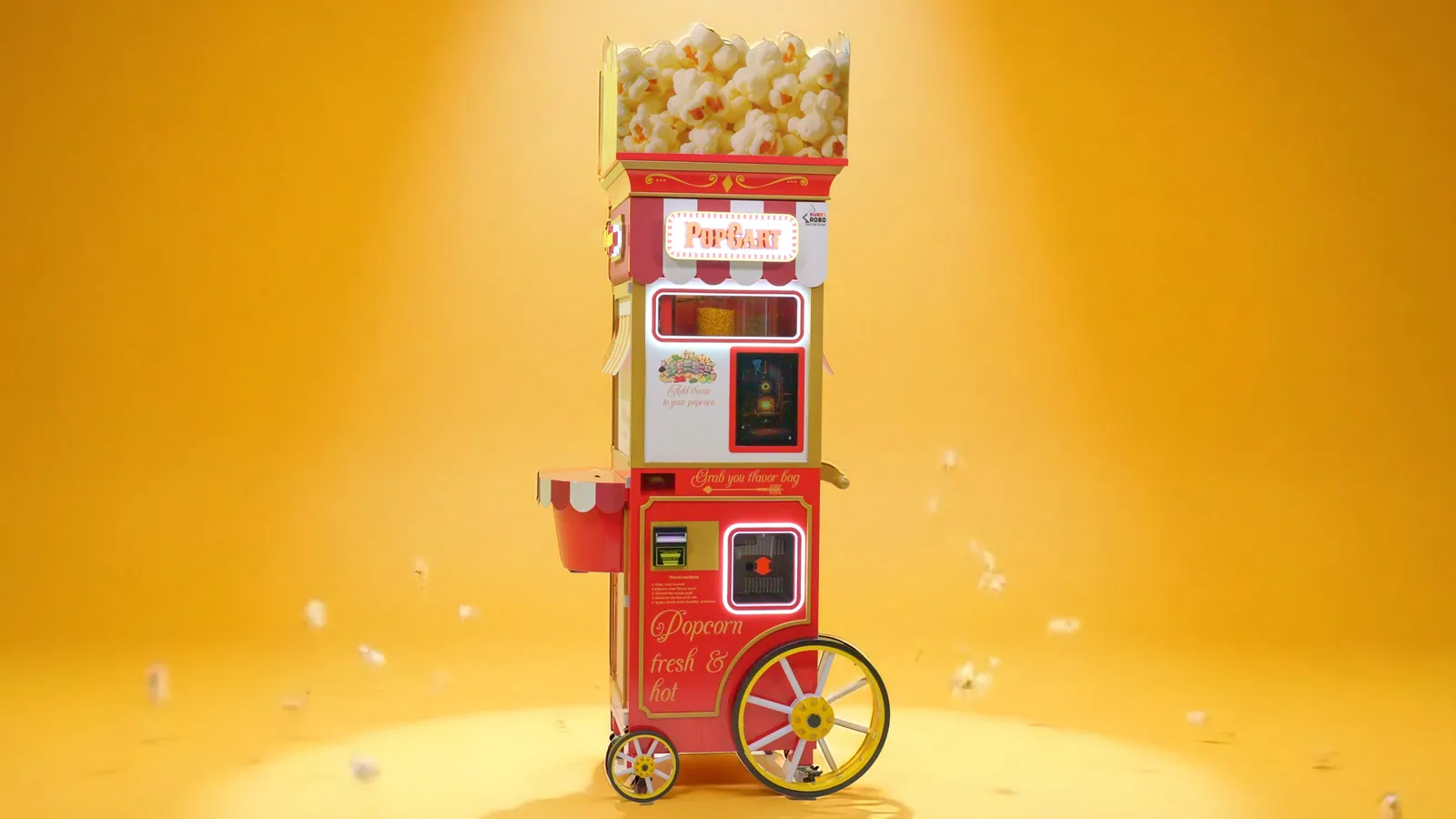
Quick answer: Traditional concession stand equipment — poppers, cotton candy spinners, warmers — is cheap to buy and expensive to run, because every piece needs a person behind it. Robotic concession machines make the same treats on demand and take payment themselves, so the stand can sell during every hour the venue is open instead of only the hours you can staff.
Key takeaways
- The equipment is rarely the expensive part of a concession stand — the shift is.
- Staffed stands sell only during peak hours, because that is the only time staffing them is justified.
- Robotic machines sell the same core concession products — cotton candy, popcorn, ice cream, candy — unattended.
- One robotic machine occupies a fraction of the footprint of a staffed counter.
- What a robotic machine sells varies widely with location, season and how it’s run — some do very well, others don’t, and Sweet Robo doesn’t publish earnings figures.
Anyone pricing concession stand equipment quickly finds the same thing: the poppers and spinners are affordable, and the business case still does not close. That is because the equipment list is not what makes a concession stand expensive. Labor is. Here is how the numbers actually work, and what changes when the equipment runs itself.
The real cost structure of a concession stand
A staffed stand has four cost lines, and only one of them is the equipment:
- Equipment — a one-time purchase, and the cheapest item on this list over time.
- Labor — recurring, scheduled, and required for every hour the stand is open.
- Product — very low for classic concession items; cotton candy and popcorn are close to pure margin.
- Space — a counter, storage, and a service area, usually the most valuable square footage in the building.
The consequence is a scheduling trap. Because labor is per-hour, you only staff the stand at peak. The stand is therefore dark for most of the day, while the space and the equipment sit idle and the venue’s off-peak visitors buy nothing.
What changes when the equipment sells for itself
A robotic concession machine collapses lines 2 and 4. Sweet Robo’s PopCart pops fresh popcorn on demand and takes cashless payment. The Cotton Candy Robot spins and shapes a cloud live. The ice cream machine dispenses, tops, seals and spoons a cup in about 30 seconds. The candy machine fills a themed cup with a branded candy mix.
| Staffed concession stand | Robotic concession machine | |
|---|---|---|
| Hours it can sell | Only when staffed | Every hour the venue is open |
| Labor per shift | Required | None |
| Footprint | Counter + prep + storage | The machine |
| Payment | Register and cash handling | Integrated cashless |
| Off-peak service | Stand is closed | Machine stays available |
| Draws its own crowd | Depends on the attendant | Yes — the machine is the show |
The last row is the one venue managers care about most. A popper behind a counter is equipment. A robot building a treat behind glass is an attraction that holds foot traffic — which is why many venues actively want one on the concourse.
Questions about how these machines work?
Talk to a specialistThe products map almost exactly
This is not a different product category, which is what makes the upgrade straightforward. The classic concession menu — cotton candy, popcorn, ice cream, candy, lollipops — is precisely what these machines make. A venue is not asking guests to accept something new; it is serving the same treats without the counter.
Two things do change, both in the operator’s favor. Consistency: the machine makes the same portion the same way at 9pm on a Tuesday as at 2pm on a Saturday. And hygiene handling: the product is prepared and enclosed by the machine rather than handled and bagged by staff.
Where the automated version fits best
- Cinemas — popcorn and candy, exactly the existing menu, with no lobby staffing.
- Bowling alleys, arcades and trampoline parks — long dwell time, families, an obvious treat moment.
- Family entertainment centers and indoor playgrounds — cotton candy and balloons in celebration mode.
- Amusement parks, water parks and boardwalks — ice cream and cotton candy, seasonal peaks handled without seasonal hiring.
- Stadiums and event spaces — concourse positions where a full stand cannot fit.
If you are an operator placing machines into venues like these, start with the vending machine business guide.
When a staffed stand still wins
Straight answer: a staffed stand wins when the menu is wide and made-to-order in ways a machine cannot cover — hot food, drinks poured to order, a full snack bar. It also wins at very large single events where throughput is everything and you can afford a crew for the day.
For the treat end of the menu specifically — the cotton candy, popcorn, ice cream and candy that carry the margin — the machine covers the same products for more hours at lower cost. Many venues run both: a staffed bar for food and drinks, robotic machines for treats.
Frequently asked questions
What equipment do you need for a concession stand?
A traditional concession stand needs a popcorn popper, a cotton candy spinner, warmers or a freezer depending on the menu, a register and cash-handling setup, plus counter and storage space. The equipment is usually the smallest recurring cost. Labor is the largest, because every open hour has to be staffed, which is why many venues now run robotic machines for the treat portion of the menu instead.
How much does concession stand equipment cost?
Individual pieces of traditional concession equipment are affordable relative to the rest of the operation, which is why the equipment budget rarely decides the business case. What decides it is the staffing schedule: a stand only sells during hours you can justify paying someone. Robotic concession machines cost more up front and remove that scheduling limit entirely.
Can a concession stand run without staff?
The treat portion can. Robotic machines make cotton candy, popcorn, ice cream and candy on demand, take cashless payment and run unattended, reporting stock and sales to the operator remotely. Hot food, poured drinks and made-to-order items still need a person, so many venues run a staffed counter for food and machines for treats.
Is a concession stand profitable?
The classic concession products carry very high margins — cotton candy and popcorn cost cents to make and sell for several dollars. Profitability usually fails on labor and limited hours rather than on product margin. Removing the staffing requirement lets those items stay on sale for the whole day rather than a two-hour window, though how much actually sells still depends on the venue’s traffic, the season and how the machine is run.
What is the most profitable concession item?
Cotton candy and popcorn are the classic margin leaders, because the raw ingredients cost a few cents per serving and customers pay several dollars for a fresh one. Both are also visually dramatic to prepare, which is why an automated version that makes them in view draws more attention than an equivalent packaged product sitting behind glass.
Related reading: are popcorn vending machines profitable · rent a popcorn machine · commercial popcorn machine · where to put a vending machine
Running a venue with a concession problem? See the machines or talk to the team about what fits your concourse.