
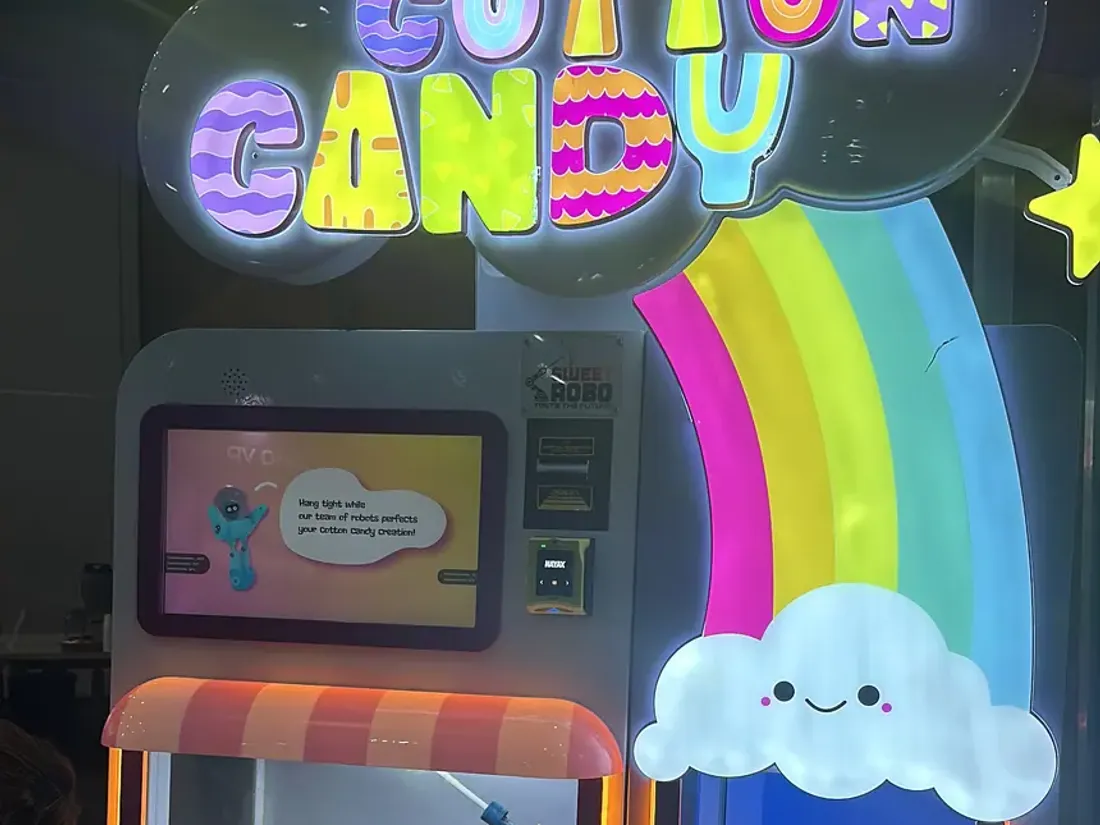
Quick answer: Renting a cotton candy machine is the right call for a single party — you pay once, someone drops it off, and you are done. It stops being the right call when cotton candy becomes recurring, because rental fees repeat, someone still has to spin every cone, and you own nothing at the end. A robotic machine spins, shapes, serves and takes payment on its own.
Key takeaways
- A rented spinner is equipment; someone still has to stand behind it and work it.
- Rental fees are a cost per event; an owned machine is equipment that can keep selling between events.
- Sweet Robo’s Cotton Candy Robot spins and shapes a fresh cloud and takes cashless payment unattended.
- The rent-or-buy question is how often you need it and whether there is a paying public.
- What a machine sells in a venue varies widely — by location, season and how it’s run. Some do very well and some don’t.
“Rent a cotton candy machine” is searched far more than “buy” one, which makes sense — most searchers are planning one event. But a meaningful share are venue managers, event businesses and rental companies renting the same spinner over and over, and for them the rental is the most expensive way to serve cotton candy. Here is the honest comparison.
What a rental actually gets you
A cotton candy machine rental typically includes the spinner, a sugar and cone kit, and a delivery window. What it does not include is the work:
- An operator. A traditional spinner is a manual tool. Someone loads the sugar, spins each cone, and hands it over — one at a time.
- The mess. Sugar goes everywhere. Cleanup is on you or costs extra.
- Availability. Peak weekends are exactly when the rental inventory in your area is already booked.
- Nothing at the end. Ten events is ten fees and no asset.
For one birthday party, all of that is fine. For a venue that wants cotton candy every weekend, it is a recurring bill with a labor tail attached.
The three ways to have cotton candy
| Rented spinner | Owned commercial spinner | Robotic machine | |
|---|---|---|---|
| Cost shape | Fee per event, forever | One purchase | One purchase |
| Who makes the cone | A person, one at a time | A person, one at a time | The machine |
| Takes payment | No | No — you handle cash | Integrated cashless |
| Sells between events | No | Only when staffed | Yes, whenever the venue is open |
| Portion consistency | Varies by operator | Varies by operator | Identical every time |
| Best for | One-off parties | Frequent staffed events | A venue or route with foot traffic |
The middle column is where most people land and where the money quietly leaks: you own the equipment but still pay a person every time it runs.
Questions about this machine? Talk it through with a specialist.
Talk to a specialistWhat the robotic version changes
Sweet Robo’s Cotton Candy Robot is a cotton candy machine with the attendant removed. A customer picks a color and a shape on screen, a robotic arm spins the cloud and shapes it, and the machine takes cashless payment. There is no shift to schedule, no cash to reconcile, and no line moving at the speed of one pair of hands. For counters and small retail there is a countertop version with the same automation in a smaller footprint.
Two things follow. It sells on ordinary days — a mall concourse or FEC lobby has traffic on Tuesday afternoon, and no one would staff a spinner for that. It still needs regular refills, cleaning and checks; unattended doesn’t mean no work. And it is the attraction, not just the product: a robot sculpting a pink cloud behind glass stops people, they film it, and the line advertises the venue.
The economics are unusually simple: a serving is spun from a few cents of flavored sugar and sells for several dollars, with no spoilage — sugar does not expire the way food inventory does. Our cotton candy machine cost breakdown goes through the numbers, and how the robotic model works covers the mechanics.
Starting a cotton candy rental business
If your plan is to rent machines out rather than operate one, the robotic version is still worth considering as fleet inventory, for one specific reason: it removes the attendant from your quote. Most food-equipment rentals stall on “who is going to run it” — a machine that serves itself does not raise that question, and it lets you rent to clients who have no one to spare.
The other option for a rental operator runs in the opposite direction: place a machine permanently in a venue and sell from it, instead of renting it out by the date. That model is covered in adding a machine to a party rental business.
The rent-or-buy question
Two questions decide it:
- How often do you need cotton candy? Once a year, rent. Monthly or more, price ownership against the annual rental total.
- Is there a paying public? At a private party, cotton candy is a cost either way. In a venue with foot traffic — a mall, FEC, cinema, arcade, park — a robotic machine can sell the same sugar to the public instead.
For operators placing machines in public venues, results vary widely — by location, season and how the machine is run. We don’t publish earnings figures, because some machines do very well and some never take off.
Frequently asked questions
How much does it cost to rent a cotton candy machine?
Rental pricing varies by region and by how much sugar and cone supply is included, and is typically quoted per day or per event. The number that matters for a recurring need is the annual total: ten events means ten fees plus someone’s time at each one, and no asset at the end. Compare that total against owning rather than comparing against a single rental.
Is it better to rent or buy a cotton candy machine?
Rent for a one-off event. Buy if cotton candy recurs, and consider a robotic machine specifically if there is a paying public, because it removes the attendant and sells on ordinary days rather than only booked dates. A traditional owned spinner sits in the middle: no rental fee, but it still only sells when someone is standing behind it.
Do you need someone to operate a cotton candy machine?
A traditional spinner, yes — a person loads the sugar and spins each cone by hand. A robotic cotton candy machine does not: the customer chooses a color and shape on screen, the machine spins and shapes the cloud, and it takes cashless payment unattended. The operator refills sugar and cups and cleans, typically a few hours a week.
Can you make money with a cotton candy machine?
It can, in a location with foot traffic, though results vary widely and some machines do much better than others. The per-serving margin is favorable: a serving is spun from cents of flavored sugar and sells for several dollars, with no spoilage. What decides the outcome is the venue’s traffic, the season, the fee you agree with the venue owner and how well the machine is kept stocked and running — more than the machine itself.
How do I start a cotton candy business?
Secure the location first, then buy the machine that fits it. Talk to malls, family entertainment centers, cinemas, arcades and holiday parks about a monthly fee for the floor space, and only then choose between the full standalone robot and the countertop unit. Buying before you have a venue is the most common and most expensive mistake in this business.
Related reading: how much does a cotton candy machine cost · best cotton candy vending machine · party rental business machines · rent a popcorn machine
Cotton candy on the calendar more than twice a year? See how the robot works or talk to the team.