Quick answer: Automated retail is selling physical products without a salesperson — a store function performed by a machine. It covers four models: unattended kiosks, self-checkout, autonomous stores, and robotic machines that manufacture the product on demand. Only the last one changes what the customer receives, which is why it commands a treat price rather than a shelf price.
Key takeaways
- Automated retail is a business model, not a technology: retail without a person completing the sale.
- Most of the category automates the transaction; robotic machines automate the product.
- Automating the transaction lowers costs. Automating the product raises the price per sale.
- Unattended operation is what makes the model scale — one operator, several locations, no shifts. Machines still need restocking, cleaning and regular checks.
- There’s no typical result: sales vary widely by location, season and how each machine is run, and some machines never take off.
Automated retail is the umbrella term for a shift that has been under way for a decade and accelerated sharply since 2020: physical products sold in physical places, with no employee completing the sale. It covers everything from a self-checkout lane to a robot that spins cotton candy in a mall. Those are very different businesses wearing the same label, so this guide separates them — and shows which one actually changes the product.
The four models of automated retail
| Model | What is automated | What the customer gets | Typical ticket |
|---|---|---|---|
| Unattended kiosk / vending | The transaction | A pre-packaged item | $1–3 |
| Self-checkout | The payment step | What they picked off a shelf | Varies |
| Autonomous store | Entry, tracking, payment | Packaged goods, no checkout | Varies |
| Robotic machine | The product itself | A fresh item made on the spot | $6–$10 |
Read the third column. Three of the four models change how someone buys something they could already buy. The fourth changes what they can buy at all — and that is the difference between competing on convenience and competing on nothing.
What automated retail solves for operators
The model exists because the economics of staffed retail stopped working in a lot of places. Automated retail addresses three specific problems:
Labor that a location cannot justify. A cinema lobby cannot staff a treat counter for the two hours a day it would be busy. A machine covers all of the hours.
Real estate that is too small to staff. A ten-square-foot corner cannot support a person but can support a machine.
Hours nobody wants to work. Machines sell at 11pm and on public holidays without a schedule.
The result is a business a single operator can scale. Because there are no shifts, adding the second and third location is an equipment decision, not a hiring decision. Our vending machine business guide covers how that scaling actually plays out.
Want to see one of these work in person?
Book a live demoWhere robotic machines fit
Robotic vending is the newest and most commercially interesting corner of automated retail, because it is the only part that adds a product rather than removing a cashier.
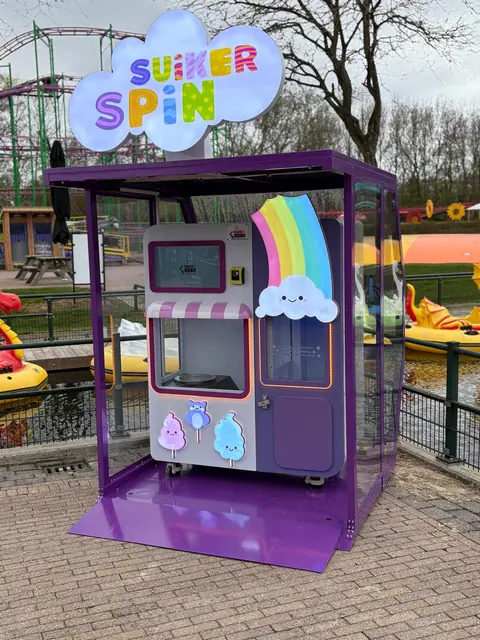
Sweet Robo’s machines make the item in front of the customer: the cotton candy robot spins a cloud and shapes it, the ice cream machine dispenses, tops, seals and spoons a cup in about 30 seconds, the balloon machine sculpts a balloon toy in about a minute, and ChocoPrint 3D-prints chocolate to order.
That production step does two commercially useful things at once. It justifies a treat price instead of a shelf price. And it draws its own audience: people stop to watch a machine build something, they film it, and the crowd advertises the venue. Ordinary automated retail has to wait for someone who already wanted the thing. A robotic machine creates the want on the spot — the effect we cover in interactive vending machines.
What automated retail requires to work
The model is not free of operational reality. Three things decide whether a machine sells:
- Foot traffic. Automation removes staff, not customers. A machine in a quiet corridor is a quiet machine.
- Cashless payment. At impulse prices, card and phone payments are now the majority of transactions.
- Remote visibility. Stock levels, sales and faults have to reach the operator, or the savings on staff get spent on drive-by checks.
Sweet Robo machines ship with cashless payment and remote monitoring as standard, and the company includes setup, training and access to a US-based support team — the last being the part imported equipment most often leaves out.
Is automated retail actually growing?
The visible evidence is easy to check: self-checkout has become the default in grocery, unattended kiosks have moved from airports into malls, gyms and hospitals, and robotic food machines have gone from novelty to fixtures at family venues. Sweet Robo alone has placed 2,300+ machines across 30 countries with venue partners including Marriott, Universal Studios, Hersheypark and IKEA.
What is worth noticing is which part is growing fastest. Automating a checkout saves a retailer money once. Adding a machine that makes something nobody else on that concourse can make adds a revenue line that did not exist.
Frequently asked questions
What does automated retail mean?
Automated retail means selling physical products in a physical location without an employee completing the sale. It covers unattended vending kiosks, self-checkout, autonomous checkout-free stores, and robotic machines that manufacture the product on demand. The common thread is that the store function — selection, payment, fulfillment — is performed by the machine rather than a person.
What is the difference between vending and automated retail?
Vending is one model within automated retail. Traditional vending dispenses a pre-packaged item; automated retail is the wider category that also includes self-checkout, autonomous stores and robotic machines that make the product on the spot. The distinction matters commercially: dispensing competes on convenience, while making the product competes on the experience.
Is automated retail profitable?
It can be, and profitability depends far more on the location and the price per sale than on the technology. Machines with a low ticket and a packaged product compete directly with nearby shops. Robotic machines that make a fresh treat sell at several dollars from ingredients costing cents. Even so, there’s no typical result: sales swing widely with placement, season and how the machine is run, and some machines never take off.
What technology does automated retail use?
The baseline is cashless payment, a touchscreen interface, and network connectivity that reports sales, stock and faults to the operator remotely. Advanced systems add robotics that prepare the product, computer vision, and software that guides the customer through customizing what they are buying. Sweet Robo’s machines combine on-demand robotic production with cashless payment and remote monitoring.
Does automated retail need staff?
Not on site. That is the definition of the model. An operator still restocks consumables, cleans the machine and reviews performance, but typically a few hours per week rather than a scheduled shift, and stock and fault data arrive remotely so visits are planned rather than guessed.
Related reading: what is a smart vending machine · interactive vending machines · robotic vending machine company · types of vending machines
Want to see the part of automated retail that makes the product? Explore Sweet Robo’s machines or talk to the team.