
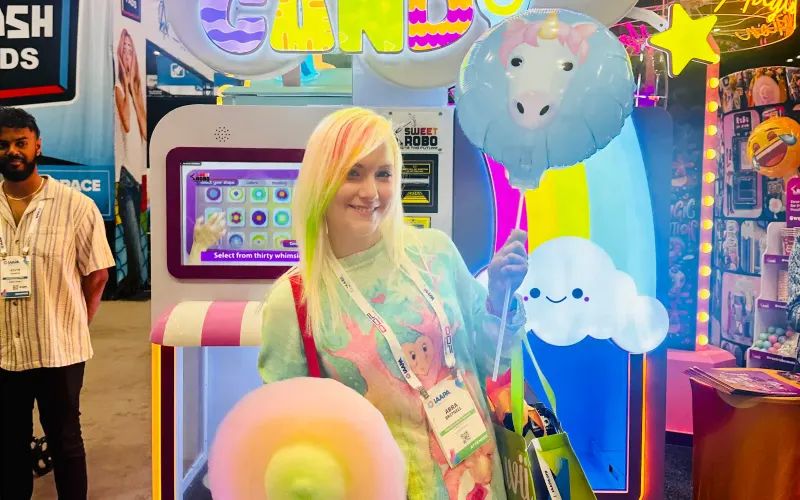
Quick answer: The types of vending machines fall into two broad worlds. The old world is traditional vending - snack, soda, and coffee boxes that drop a pre-packaged item down a chute. The new world is robotic and interactive: machines that make a fresh product on demand and put on a show, from perfume and protein shakes to spun-to-order cotton candy. Traditional vending still exists, but the market has clearly moved toward fresh, automated, experience-driven machines - and among those, a robotic cotton candy machine is one of the strongest choices in 2026.
Key takeaways
- The types of vending machines split into traditional (snack, soda, coffee) and modern robotic/interactive machines that make a fresh product live.
- Traditional vending isn’t dead, but it’s a mature, low-margin, low-excitement category that the market has largely moved past.
- The growth is in machines that make something on demand and draw a crowd - fresh treats, beauty, fitness, and experience machines.
- Robotic machines win on the things that matter now: automation, a fresh made-to-order product, an interactive show, and no on-site staff.
- Of all the modern types, a robotic cotton candy machine stands out for high margins, low cost of goods, universal appeal, and a show that markets itself.
- Sweet Robo builds robotic, US-supported machines - cotton candy, ice cream, and more - with warranties, onboarding, and training included.
If you’re researching the types of vending machines available in 2026, you’ll quickly notice that “vending machine” no longer means what it did ten years ago. The category has split in two. On one side sit the classic boxes most people picture - snacks, soda, coffee. On the other sits a fast-growing wave of robotic and interactive machines that make a fresh product on the spot. This guide maps the full landscape, explains why the traditional side feels increasingly dated, and shows why one modern type in particular - the robotic cotton candy machine - keeps rising to the top.
The classic categories: traditional vending machines
Start with the machines everyone already knows. For decades, “vending machine” meant one of a handful of familiar formats, and they still make up a large share of the installed base.
Snack machines. The spiral-coil box that drops a bag of chips or a candy bar. Simple, reliable, and everywhere - offices, schools, gas stations. It dispenses a pre-packaged item that was made in a factory somewhere else.
Soda and beverage machines. The refrigerated column that sends down a can or bottle. A staple of break rooms and hallways, built around cold storage and a narrow menu of drinks.
Coffee machines. The traditional office coffee box that mixes hot water with powder or brews a basic cup. A step up in “making” something, but usually a low-quality result compared to a real café.
Combo and mechanical machines. Snack-and-drink combos, gumball and bulk-candy globes, sticker and toy dispensers. Cheap, mechanical, and largely unchanged for a generation.
These machines all share one defining trait: they dispense rather than make. The product already exists; the machine just hands it over. That’s the quiet reason the whole traditional category now feels dated, and it’s the thread that runs through the rest of this guide.
How vending evolved: from dispensing to making
The single biggest shift in vending isn’t a new snack or a new payment system. It’s the move from dispensing a pre-made item to making a fresh product on demand. That one change rewrites everything about what a machine can charge and why a customer stops.
A traditional machine competes on convenience alone. The chips in the snack box are the same chips sold at the store next door, so the only reason to buy from the machine is that it’s there. That caps both the price and the appeal. There’s no reason to stop and watch a box drop a bag of chips, and no reason to pay a premium for it.
A machine that makes something fresh competes on experience. When a robot arm spins cotton candy, swirls soft serve, or prints a design in chocolate, the customer isn’t buying convenience - they’re buying a moment. They stop, watch, film it, and pay more, because the product is fresh and the process is fun. That’s a completely different economic engine bolted onto the same basic idea of an unattended machine.
This is also where automation and payments finally caught up. Modern machines are fully cashless, connected, and unattended, so they can make a complex fresh product with no staff on site. Put those two shifts together - making instead of dispensing, plus true automation - and you get the modern wave of machine types that traditional vending simply can’t match. If you want the deeper background, see what is a smart vending machine and what is an AI vending machine.
A brief history: how vending machines got here
To understand why the category is splitting, it helps to see how it grew. Vending has always been about removing the person from a simple transaction, and each era pushed that idea a little further.
The earliest machines were purely mechanical: drop a coin, turn a knob, receive a fixed item. For most of the twentieth century, that was the whole story - gum, stamps, cigarettes, then snacks and cold drinks as refrigeration and reliable coin mechanisms matured. The machine was a metal cabinet with a spring coil or a chilled column, and the “technology” was the payment mechanism, not the product. The product was always pre-made.
The next leap was electronic and digital: bill validators, then card readers, then fully cashless and connected machines with remote monitoring. This made machines smarter about payments and inventory, but the thing they handed you was still a factory-made item. A connected soda machine is still a soda machine. For decades, in other words, vending got better at selling the same commodities more conveniently, without changing what it fundamentally did.
The current leap is different in kind, not just degree. For the first time, the machine makes the product. Robotics, food-safe automation, and precise dispensing let an unattended cabinet spin cotton candy, swirl soft serve, or print in chocolate - tasks that used to require a person behind a counter. That’s why 2026 feels like a genuine turning point rather than another incremental upgrade: the machine stopped being a warehouse with a coin slot and became a tiny, automated maker. Everything in the modern tour below flows from that shift.
Not sure which machine is the right fit for you?
Compare with an expertThe modern wave: a tour of today’s machine types
Here’s where the landscape gets interesting. Beyond the classic boxes, a whole spectrum of new machine types has appeared - each built around making or delivering something fresh, personal, or experiential. This is the part of the market that’s actually growing, so it’s worth touring the main categories one by one.
Fresh-treat and dessert machines
This is the flagship of the modern wave: machines that make a sweet treat live, on demand. Spun-to-order cotton candy, soft-serve ice cream, fresh popcorn, and 3D-printed chocolate all belong here. They’re the clearest example of “making, not dispensing,” and they draw the biggest crowds because the process itself is the marketing. We’ll come back to why cotton candy leads this group, because it’s the machine most worth owning in 2026.
Beauty and lifestyle machines
One of the faster-growing modern categories has nothing to do with food. Beauty and lifestyle machines dispense premium personal products in high-traffic, high-dwell venues like malls, airports, and hotels, where shoppers are already in a spending mood. A modern perfume vending machine, for example, lets customers sample and buy fragrance on the spot, turning an impulse into a sale in a footprint the size of a phone booth. It’s a good illustration of how far the category has traveled from a soda column.
Health and fitness machines
As gyms, studios, and wellness centers looked for unattended revenue, a fitness-focused machine type emerged. Instead of candy, these dispense functional nutrition - and the most advanced ones actually make the drink fresh rather than handing over a bottle. A protein shake vending machine can blend a made-to-order shake right after a workout, which is exactly the “make, don’t dispense” logic applied to a completely different audience. It’s another sign that the growth in vending is happening at the fresh, experiential end.
Experience and entertainment machines
Some modern machines sell an experience outright, with the product as a souvenir. The clearest example is a photo machine: an AI photo booth machine that captures, styles, and prints a keepsake in seconds. These thrive on the same crowd-drawing dynamic as fresh-treat machines - people gather, participate, and share - which is precisely the engagement that a traditional snack box can never generate. Entertainment machines prove the point that the modern category competes on the moment, not just the merchandise.
Modern beverage machines
Even the humble drinks machine has been reinvented. The old soda column dispensed a can; the modern version makes the drink. A barista-style specialty coffee vending machine grinds beans and pulls a fresh cup on demand, closing much of the gap with a real café while staying fully unattended. It’s the same evolution playing out in the drinks aisle: from dispensing a pre-made product to making a fresh one, which is the whole story of where vending is headed.
Custom and novelty machines
The long tail of modern vending is full of specialty formats - custom-printed products, collectibles, and 3D-fabrication machines. A chocolate-printing vending machine, for instance, 3D-prints edible designs to order, blurring the line between a vending machine and a tiny automated factory. Sweet Robo’s own lineup lives in this modern-and-custom world too, from the phone case printer to fully custom vending machines built for a specific venue. What every machine in this section has in common is that it makes or personalizes something - the opposite of the old dispense-only box.
Step back from the tour and the pattern is unmistakable. Every growing machine type - beauty, fitness, experience, fresh beverages, custom fabrication, and especially fresh treats - is built on making something on demand. The traditional snack-and-soda box is the one format that isn’t evolving, which is exactly why it’s slipping into the past.
Traditional vs. robotic: why the old boxes are the past
Put the two worlds side by side and the gap is stark. It’s not that traditional vending stopped working - plenty of snack and soda machines still turn a modest profit. It’s that the ceiling on that model is low and getting lower, while the robotic side keeps growing.
Traditional machines are stuck competing on convenience and price. The product is a commodity anyone can buy elsewhere, so margins are thin, the customer has no reason to stop and watch, and there’s nothing to share or talk about. Placement is a grind because the machine offers a venue nothing special. And because the format has barely changed in decades, the whole category has become background furniture.
Robotic machines flip every one of those disadvantages into an advantage. The product is fresh and made-to-order, so margins are healthy and the price supports a premium. The process is a show, so the machine draws its own crowd and effectively advertises itself. Venues want it because it adds an attraction, not just a snack. And because the experience is novel and photogenic, customers share it, which brings more customers. For a closer look at that dynamic, see interactive vending machines and best vending machines to own.
There’s a reliability wrinkle worth naming, though. A machine that makes a fresh product has moving parts and a live process, which raises the stakes on support and spare parts. That’s why, among robotic machines, the manufacturer behind the machine matters as much as the machine itself - a point covered in depth in best robotic vending machine and American-made vs. imported vending machines. The modern category wins, but only when the machine is genuinely supported.
Why cotton candy is still the best of the modern machines
Of all the modern machine types, one keeps coming out ahead for a first-time or scaling operator: the robotic cotton candy machine. It’s not the flashiest claim in the guide, so here’s the specific, checkable reasoning behind it.
The margins are exceptional. Cotton candy is essentially sugar and flavor - a tiny cost of goods that spins into a large, high-perceived-value product. Few machine types convert raw material into retail price as efficiently, which is a big part of why operators favor it.
The appeal is universal. Perfume, protein, and coffee each target a slice of the market. Cotton candy targets nearly everyone - kids, families, event crowds - across almost any venue with foot traffic. Broad appeal means it suits more venues and is easier to place.
The show is unbeatable. Watching a machine spin a fresh cloud of cotton candy is genuinely mesmerizing, and it’s the kind of moment people film and post. That built-in, shareable spectacle is marketing you don’t pay for, and it’s stronger with cotton candy than with almost any other product.
The operation is simple. Compared with machines that juggle refrigeration, complex ingredients, or fragile electronics, a cotton candy machine is straightforward to run and maintain - especially with training and support behind it.
Put those together and cotton candy hits the rare combination of high margin, broad appeal, powerful show, and simple operation. That’s why, after touring every modern type, it remains the machine we’d point most operators toward. You can dig into the specifics on the cotton candy vending machine page, the commercial cotton candy machine overview, or how much robotic vending machines make for what actually drives sales.
Where Sweet Robo fits in the modern lineup
Sweet Robo builds squarely in the modern, robotic half of this landscape. Its machines don’t dispense pre-packaged items; they make a fresh product live and put on the interactive show that defines the category. Spun-to-order cotton candy comes off the Cotton Candy machine (VX and Mini Pro), soft serve from Robo Ice Cream, and the range extends to Balloon Bot, PopCart popcorn, Candy Monster, ChocoPrint, and Case Bot.
Because these machines make something in front of the customer, the support wrapped around them is part of the product, not an afterthought:
- US-based lifetime support by video and chat.
- Warranties included.
- Setup, training, and maintenance guidance from day one.
- Full automation with a fresh, made-to-order product and no on-site staff.
Per Sweet Robo, startup can begin as low as around $4,000. What a machine sells after that varies widely - by venue, season, and how it’s run - and Sweet Robo doesn’t publish earnings figures, because some machines do very well and others don’t. To see the full range, browse Sweet Robo’s machines or explore the vending machine business model end to end.
Want a straight recommendation for your space?
Compare with an expertHow to choose the right type of vending machine
Knowing the types is one thing; picking the right one for your situation is another. The best choice depends on your goals, your budget, and - above all - the venues you can realistically access. A few questions cut through most of the confusion.
Who is your audience, and where will the machine live? A perfume or coffee machine suits a mall, airport, or office lobby full of adults with disposable income. A fresh-treat machine like cotton candy or ice cream suits family venues, entertainment centers, resorts, and events. Start from the venue you can actually get, then choose a machine type that matches its crowd - not the other way around.
Do you want a convenience machine or an attraction? Traditional machines are pure convenience plays with thin margins and little to set them apart. Robotic machines are attractions with a higher price per item, but they depend on a good, high-traffic spot and reliable support, and results vary widely from one venue to the next. If you can secure a strong location and want something that stands out, the attraction model is the one to look at.
How hands-off do you need it to be? Every type here is unattended, but some are simpler to run than others. Machines with heavy refrigeration or complex ingredients ask more of you than a straightforward fresh-treat machine. If you’re starting out, favor a type that’s easy to operate and comes with training, so you’re not learning on live equipment.
What’s your real budget, including the things that protect uptime? Compare total cost of ownership, not just the sticker price - support, warranty, parts, and training all belong in the math. A machine that’s cheaper to buy but slower to fix can cost more over a year. The best robotic vending machine guide walks through exactly how to weigh that.
Answer those four honestly and the field usually narrows to one or two types. For most operators who can secure decent foot traffic, that shortlist ends up including a robotic fresh-treat machine - and often cotton candy specifically, for the reasons above.
Matching machine type to the right venue
Because placement has such a big effect on sales, it’s worth pairing machine types with the venues where they fit. The same machine can thrive in one spot and stall in another, so the match matters more than almost any spec.
- Family entertainment centers, playgrounds, and trampoline parks are natural homes for fresh-treat machines like cotton candy and ice cream, where families are already in a fun, spending mood.
- Malls, airports, and hotel lobbies suit beauty, coffee, and experience machines aimed at adults with time to browse and money to spend.
- Gyms and wellness centers fit fitness-focused machines that make functional drinks right where the workout ends.
- Resorts, waterparks, and event spaces reward crowd-drawing machines that turn a wait or a walk-by into an impulse buy.
The through-line is dwell time and mood: the best venues give people a reason to pause and a reason to treat themselves. Getting into those spots is the hard part, and the machine and the location have to be chosen together. Our guide to where to put a vending machine covers what to look for and how to approach a venue. If you’re mapping this out, the vending machine business overview is a good place to think it through before committing a machine to a spot.
The technology layer running across every type
Cutting across all of these categories is a technology layer that didn’t exist a decade ago, and it’s part of why the modern machines pull so far ahead. “Smart” vending isn’t a separate type so much as a set of capabilities now baked into the best machines, old-format or new.
The first piece is payments and connectivity. Modern machines are cashless by default - tap, card, or mobile - and connected to the internet, so an operator can watch sales, track inventory, and get alerts from a phone. That alone removes the two biggest headaches of old-school vending: coin handling and blind restocking. It also means a machine can be truly unattended without going dark on you.
The second piece is intelligence. Cameras, sensors, and software let machines respond to the customer - guiding a selection, personalizing a product, or running the interactive show that makes robotic machines so magnetic. This is the difference between a box that waits and a machine that engages. The deeper explanation lives in what is a smart vending machine and what is an AI vending machine, but the short version is that intelligence turns a dispenser into an experience.
The reason this matters for a buyer is simple: the technology layer amplifies whatever the machine already does. Bolt it onto a snack box and you get a slightly more convenient snack box. Bolt it onto a machine that makes a fresh product and puts on a show, and you get an attraction that markets itself, runs unattended, and reports its numbers to your phone. That’s why the smartest machines and the most modern types tend to be the same machines - and why the gap with traditional vending keeps widening.
Types of vending machines: a quick comparison
| Machine type | Makes or dispenses? | Margin | Draws a crowd? | Fits 2026? |
|---|---|---|---|---|
| Snack / soda | Dispenses pre-made | Low | No | Fading |
| Traditional coffee | Basic mixing | Low-medium | No | Fading |
| Beauty / lifestyle | Dispenses premium goods | Medium-high | Some | Growing |
| Fitness / protein | Can make fresh | Medium-high | Some | Growing |
| Experience / photo | Makes a keepsake | High | Yes | Growing |
| Fresh treats (cotton candy, ice cream) | Makes fresh, live | High | Strongly | Leading |
Frequently asked questions
What are the main types of vending machines?
The main types split into traditional and modern. Traditional vending machines - snack, soda, and coffee boxes - dispense a pre-packaged item down a chute. Modern machines make a fresh product on demand: fresh-treat machines like cotton candy and ice cream, plus beauty, fitness, experience, and custom-fabrication machines. The clear market trend is away from dispense-only boxes and toward robotic, interactive machines that make something live and draw a crowd.
Are traditional vending machines still worth it in 2026?
They still work, but the ceiling is low. Snack and soda machines sell commodities anyone can buy elsewhere, so margins are thin, there’s no reason for customers to stop and watch, and placement is a grind. Robotic machines that make a fresh product carry higher margins per item, draw their own crowd, and are easier to place because venues see them as an attraction. For most new operators, the modern category is the stronger bet.
What is the most profitable type of vending machine?
There’s no single answer, because profit depends far more on the venue, the season, and how the machine is run than on the type alone. Per serving, fresh-treat machines tend to carry the best margins, and robotic cotton candy stands out: it has a very low cost of goods, a high perceived value, near-universal appeal across venues, and a mesmerizing show that markets the machine for free. A strong margin per serving doesn’t guarantee strong sales, though - some machines do very well and some don’t.
What’s the difference between a robotic and a traditional vending machine?
A traditional vending machine dispenses a pre-packaged item that was made elsewhere; a robotic vending machine makes a fresh product on demand and performs an interactive show while doing it. That difference changes the economics: robotic machines command premium pricing, draw crowds, and generate shareable moments, while traditional machines compete only on convenience. Robotic machines also require stronger support and faster parts because they have a live process and moving parts.
Does Sweet Robo make traditional vending machines?
No. Sweet Robo builds robotic, interactive machines that make a fresh product live - cotton candy, soft-serve ice cream, popcorn, chocolate, and more - rather than dispense-only snack or soda boxes. Every machine is fully automated and unattended, and it ships with US-based support, an included warranty, and training, which matters more for a machine that makes a product than for one that simply drops an item.
Related reading: best robotic vending machine, interactive vending machines, and best vending machines to own., what is automated retail, unique vending machines
Ready to own the modern side of the category? Browse Sweet Robo’s machines to see the full robotic lineup, start with the cotton candy vending machine, or explore the vending machine business model - each backed by US-based support, included warranties, and training.