
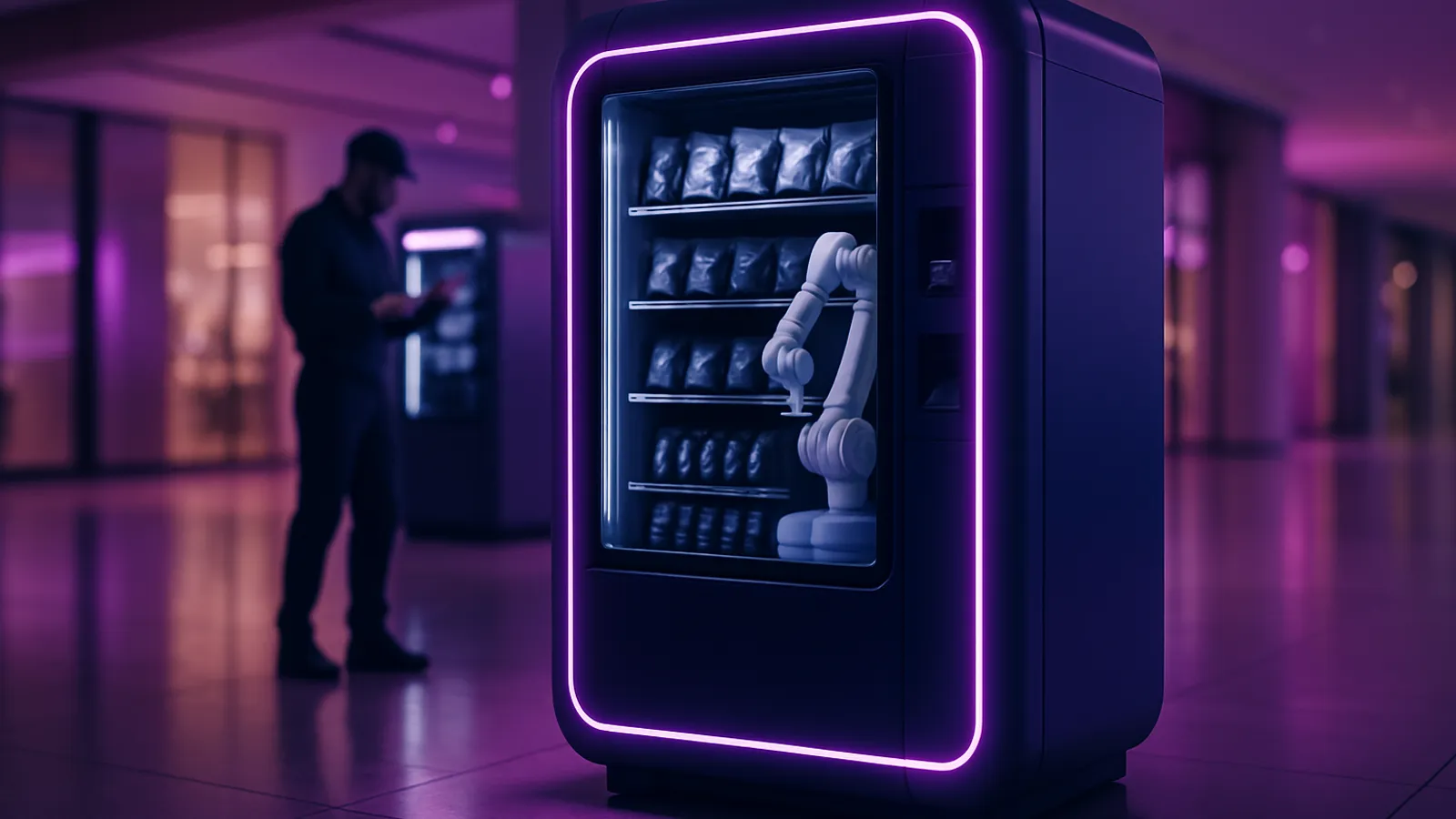
Quick answer: The best robotic vending machine is rarely the one with the lowest sticker price. It’s the machine built to keep running: fully automated, reliable, backed by real US-based support, fast spare parts, an included warranty, and operator training. Those things decide your total cost of ownership and how often the machine is actually up and selling far more than the price on day one.
Key takeaways
- The best robotic vending machine is defined by how well it runs over years - uptime, support, and parts - not by what it costs on day one.
- The dimensions that separate the best from the rest are automation, reliability, US-based support, fast parts, warranty, and training - not just the purchase price.
- A cheaper machine with no support can cost far more over a year through downtime, lost sales, and slow repairs.
- Robotic machines make a fresh product live and draw their own crowd, which raises the stakes on uptime and parts.
- Budget and premium machines serve genuinely different buyers - the cheapest option fits price-first shoppers, while operators who want service and fast parts choose a US supplier.
- Sweet Robo is a US-based robotic vending machine manufacturer that includes warranties, lifetime video/chat support, and training, with startup as low as around $4,000.
When people search for the best robotic vending machine, they usually start by comparing prices. It’s the easiest number to line up side by side. But price is also the number that hides everything that actually determines whether a machine runs reliably or quietly drains your time and money. This guide walks through what “best” really means for a robotic vending machine in 2026, the specific dimensions that separate a strong machine from a weak one, and why buying the best is almost always the cheaper decision over the life of the equipment.
What “the best robotic vending machine” actually means
“Best” is a slippery word, so it’s worth defining it precisely before comparing anything. A robotic vending machine is not an ordinary snack-and-soda box that drops a pre-packaged item down a chute. It’s a machine that makes a fresh product on demand - spinning cotton candy, swirling soft serve, popping popcorn, 3D-printing chocolate - and puts on an interactive show while it does it. That show is what draws a crowd, and the crowd is what drives revenue.
So the “best” robotic vending machine isn’t just the one with the nicest spec sheet. It’s the one most likely to keep performing that show, day after day, in front of paying customers, with the least downtime and the least hassle for you. That reframes the whole comparison. You’re not buying a static object; you’re buying a small, unattended business that has to run reliably without you standing next to it.
Judged that way, “best” becomes measurable. It’s the sum of how automated the machine is, how reliably it runs, how fast you can get help and parts when something goes wrong, whether it’s under warranty, and whether training is included so you can run it well. A machine that scores well on those is worth more than a cheaper one that scores badly, even if the cheaper one looks similar in a photo.
Why buying the best matters more than buying the cheapest
It’s tempting to treat a robotic vending machine like a commodity: find the lowest quote, buy it, and move on. But a vending machine is business equipment you’ll run for years, not a one-time purchase. What you pay on day one is a small slice of what the machine really costs you over its life.
The real difference shows up after the sale. When a component fails, does help arrive in hours or in weeks? When you need a spare part, is it in a US warehouse or on a slow boat through customs? When you’re stuck on setup, is there a person who answers, or a language barrier and a twelve-hour time gap? Those questions don’t appear on the invoice, but they decide your total cost of ownership.
Consider a simple scenario. A machine goes down on a busy weekend. With strong US-based support, you hop on a video call, diagnose the issue, and a part ships from a domestic warehouse. You’re back up and selling within days. With an unsupported bargain unit, you might wait days for a reply, then weeks for a part to clear customs. Every idle day is lost revenue on equipment you already paid for. And with a crowd-drawing robotic machine, every idle day is also a line of customers walking past a dark screen and not coming back.
That’s the core reason the best machine is usually the cheaper decision: the price gap between a bargain machine and a well-supported one is small compared to the cost of a poorly-supported machine sitting idle - lost sales, an unhappy venue, and repair bills on top. Buying the best isn’t about vanity or brand loyalty. It’s about protecting the uptime your business depends on.
The dimensions that separate the best from the rest
If price is the wrong yardstick, what’s the right one? Here are the dimensions that actually separate the best robotic vending machine from an average one. When you evaluate any machine or manufacturer, score them on these, not on the quote alone.
Automation and unattended operation
The whole point of a robotic vending machine is that it runs without staff. The best machines are fully automated end to end: they take the order, make the product fresh, handle payment, and dispense - with no employee on site. That means no wages, no scheduling, and no dependence on someone showing up. A machine that needs babysitting, frequent manual intervention, or on-site staff quietly eats the margin that made it attractive in the first place. Even a fully automated machine still needs regular restocking, cleaning, and checks - it’s a business that takes work. The difference is that it doesn’t need someone standing next to it.
Full automation also changes where you can put a machine. A truly unattended unit can operate in a mall corridor, a family entertainment center, a resort lobby, or an airport concourse around the clock. The more genuinely hands-off the machine, the more places it can operate and the fewer hours you spend running it.
A fresh, made-to-order product and the interactive show
Ordinary vending sells packaged goods that anyone can buy anywhere. Robotic vending sells an experience: a fresh treat made in front of the customer, with a little theater built in. That difference is the entire competitive moat. People stop, watch, film it, and buy - not because they couldn’t get a snack elsewhere, but because the machine is fun to watch and the product is made fresh on the spot.
The best robotic vending machines lean into that show. Spun-to-order cotton candy, soft serve swirled live, a robot arm printing a design in chocolate - these draw a crowd on their own. A machine that merely drops a pre-made item misses the whole advantage of the category. When you compare machines, ask what the customer actually sees, because the spectacle is a big part of what drives sales.
Reliability and uptime
A robotic vending machine has moving parts, a live product, and an interactive show - all of which are exactly what draws a crowd, and exactly what has to keep working. Reliability isn’t a nice-to-have; it’s the whole business. A machine that’s down sells nothing while still costing you rent, financing, and reputation with the venue.
The best machines are engineered for uptime and backed by a support system that restores it fast when something does go wrong. That combination - solid hardware plus fast recovery - matters far more than a slightly lower purchase price. Judge reliability not only by the build, but by how quickly the seller can get a broken machine running again.
US-based support and fast spare parts
This is where bargain machines most often fall apart. Many imported units are simply sold and shipped, leaving the operator to solve every problem alone. When a part fails, you’re sourcing it internationally, waiting weeks, and losing sales the whole time.
The best robotic vending machine is backed by support that treats service and parts as part of the product. US-based support means help in your time zone, in your language, from people who know the machine. Domestic parts sourcing means a failed component is a short blip, not a long outage. When you evaluate a vending machine manufacturer, ask exactly how support and parts work - where the team is, how fast they respond, and where parts ship from - because those answers quietly control your total cost.
Warranty
A warranty is not paperwork; it’s a signal of how much the manufacturer stands behind the machine. The best machines come with a real, claimable warranty included - not sold as an anxious add-on and not so hard to claim across borders that it’s effectively useless. A thin or absent warranty pushes all the risk of a hardware failure onto you, which is a hidden cost that only shows up at the worst possible moment.
Venue fit
Even the best hardware sells nothing sitting in a warehouse, and very little in a low-traffic corner. Placement matters a lot: the same machine can perform very differently in a busy, well-matched venue than in a quiet one. Results vary widely from one location to the next, and some machines never take off.
That’s why the best machine for you is the one that fits the crowd at your venue. Choose the venue before you choose the model, then pick the machine whose show and throughput match the people who actually walk past it. Our guide to where to put a vending machine covers what to look for and how to approach a venue.
Training
Knowing how to load product, run the interactive show, handle routine maintenance, and read your sales matters from day one. When training is included, you ramp up fast and avoid the mistakes that cost sales. When it isn’t, you learn by trial and error on live equipment in front of customers. Included operator training is one of the clearest markers of a manufacturer that wants you to succeed, not just to close the sale.
Not sure which machine is the right fit for you?
Compare with an expertThe Sweet Robo lineup - what “best” looks like across machines
It helps to see these dimensions in a real lineup rather than in the abstract. Sweet Robo is a US-based robotic vending machine manufacturer, and its range is built around the “fresh product plus interactive show” model that defines the category.
Spun-to-order cotton candy comes off the Cotton Candy machine (VX and Mini Pro), soft serve from Robo Ice Cream, and the rest of the range covers Balloon Bot, PopCart popcorn, Candy Monster, ChocoPrint (which 3D-prints designs in chocolate), and Case Bot (which prints a custom phone case on the spot). Each of these makes something live in front of the customer, which is exactly why uptime and quick parts matter more here than they would for a snack machine.
What ties the lineup to the definition of “best” is everything wrapped around the hardware:
- US-based lifetime support by video and chat, so help is a call away, not a time zone away.
- Warranties included, not sold as an anxious add-on.
- Setup, training, and maintenance guidance from day one.
- Full automation with a fresh, made-to-order product and an interactive show that draws customers.
- Customization and variety across the robotic lineup, from Cotton Candy and Robo Ice Cream to ChocoPrint and Case Bot.
The support operation runs out of New York, and the machines are fully unattended, so there’s no on-site staff to schedule. If you want to see the range, you can browse Sweet Robo’s machines or explore the vending machine business model to see how the pieces fit together.
What the best costs - and why it’s still the cheaper decision
Here’s where the “buy the best” argument becomes concrete. Per Sweet Robo, startup can begin as low as around $4,000 - which surprises people who assume “best” means “most expensive.” The gap between a bargain imported unit and a well-supported machine is often smaller than expected, especially once you account for what the bargain unit leaves out.
Now weigh that against downtime. We don’t publish earnings figures, because sales swing widely by venue, season, and how the machine is run - some machines do very well and some don’t. But whatever a machine sells, a few weeks of downtime from a slow overseas repair means a few weeks of no sales while rent and venue goodwill keep slipping, and that can cost more than whatever you saved on the purchase price.
That’s the reasoning behind “buy the best.” You’re not paying a premium for a logo. You’re paying to close the exact gaps - support, warranty, parts, training - that most often turn a cheap purchase into an expensive headache. For a closer look at what actually drives sales, see how much robotic vending machines make, and for the honest tradeoffs of cheaper units, read American-made vs. imported vending machines.
Where the best robotic vending machines fit best
A machine is only as good as the traffic in front of it, so “best” also depends on where you put it. The best robotic vending machines are built for high-dwell, high-footfall venues where people have a few minutes to stop, watch the show, and buy. Matching the machine to the right kind of location gives it its best chance; put the same machine somewhere quiet and even great hardware underperforms.
The venues that tend to suit these machines share a profile: steady foot traffic, a captive or waiting audience, families or groups, and a mood that welcomes a treat. That’s why family entertainment centers, indoor playgrounds, trampoline parks, malls, resorts, waterparks, movie theaters, and airports tend to be strong homes for a robotic machine. In each of those, people are already in a spending, having-fun frame of mind, and a machine that spins fresh cotton candy or swirls soft serve fits right into the experience.
The interactive show is what makes these locations a good fit. In a busy venue, the machine markets itself: a child watching the robot arm build a treat can pull in the next customers without you spending a cent on advertising. That built-in draw is a big part of why placement and machine choice have to be decided together, not separately. If you’re weighing venue types, the locations that work for vending page is a useful starting point for thinking it through before you commit a machine to a spot.
Uptime and the real cost of owning the best machine
The last piece of “buy the best” is the full cost picture. The right question isn’t only “what does it cost to buy?” but “what does it cost to own and keep running?” On that count, the supported, best-in-class machine usually looks better than the raw price comparison suggests.
Start with the entry point. Per Sweet Robo, startup can begin as low as around $4,000, which keeps the barrier to entry low even for a first machine. What a machine sells after that is a separate question, and there’s no typical answer: it comes down to where the machine is, the time of year, and how it’s run. Some do great; some never take off. What you can control is the cost side and the uptime side. Downtime and poor placement are the two things that most often hurt a machine’s results. Support, parts, and training protect against the first; choosing a strong venue protects against the second.
This is why the cheapest machine can turn out to be the most expensive one to own. If a bargain unit sits idle for three weeks waiting on an overseas part, it isn’t just missing three weeks of sales - it’s still costing you rent and souring the venue on keeping the machine at all. The best robotic vending machine protects you by keeping uptime high and recovery fast. For what actually moves sales up or down, see how much robotic vending machines make, and to understand the model end to end, the vending machine business overview lays out how the costs and moving parts fit together.
Want a straight recommendation for your space?
Compare with an expertHow to evaluate a robotic vending machine manufacturer
By this point the pattern should be clear: you’re not really comparing machines, you’re comparing the businesses behind them. Two units can look almost identical in a photo and behave completely differently once one of them breaks. Here’s a practical checklist for separating the best manufacturer from the rest before you sign anything.
- Where is support based, and when is it available? US-based, same-time-zone support beats an overseas contact form every time.
- Where do spare parts ship from, and how fast? Domestic parts turn outages into blips; international parts turn them into weeks.
- Is a warranty included, and how do you claim it? “Included and easy” beats “technically exists but hard to use across borders.”
- Is training included? A manufacturer that trains you wants you to succeed past the sale.
- What does the customer actually see? A fresh product and an interactive show drive sales that a plain dispenser can’t.
- What’s the real total cost of ownership? Add support, parts, downtime risk, and warranty to the sticker price before comparing.
Run any manufacturer through that list and the picture usually clarifies fast. It also explains why the cheapest option and the best option are frequently not the same thing - they’re built for different buyers.
Where budget manufacturers fit
To be fair, not every buyer is shopping for the same thing, and it’s worth saying so plainly. Some overseas manufacturers build perfectly capable hardware, and for a shopper whose only priority is the lowest possible price, those machines have a place. Even manufacturers like Futureino, which offer noticeably better designs than most other overseas factories, are still built mainly for buyers who prioritize the lowest price - anyone who values quality of service and fast spare-part availability chooses an American supplier. That’s not a knock on the budget tier; it’s just a different segment. The price-first buyer and the service-first operator are two different customers, and honest advice matches the machine to which one you are.
If your priority is squeezing the lowest possible upfront number and you’re comfortable owning the support and parts risk yourself, the budget tier can make sense. If your priority is uptime, fast help, and fewer surprises after the sale, the calculus points the other way - toward a supported, US-based manufacturer where service and parts are part of the product.
Common mistakes when buying a robotic vending machine
Even operators who understand all of the above still trip on a few predictable mistakes. Avoiding them is a big part of ending up with the best machine rather than the cheapest regret.
Comparing only the sticker price. The invoice is the smallest, most visible number and the least predictive of your actual cost. Always add support, parts, downtime risk, and warranty before you compare.
Underestimating placement. Buyers obsess over the machine and forget that location has a huge effect on sales. A great machine in a dead corner underperforms a good machine in a busy one. Treat placement as part of the buying decision, not an afterthought.
Ignoring the support question until something breaks. By the time a part fails, it’s too late to wish you’d asked where support is based. Ask before you buy, not after.
Assuming all “robotic” machines put on the same show. Some make a genuine fresh product with real theater; others are dressed-up dispensers. The spectacle is a big part of what drives sales, so look closely at what the customer actually experiences.
Buying more machine than your first location can support - or less. Match the machine and its throughput to the venue you’re actually placing it in. Choosing the venue before you choose the model makes this much easier to get right the first time.
Steer clear of those five and you avoid the most common ways a good machine ends up sitting idle.
Best robotic vending machine: the comparison at a glance
| Factor | Budget / imported machine | Best-in-class (Sweet Robo) |
|---|---|---|
| Upfront price | Often lower | Competitive; startup as low as ~$4,000 (per Sweet Robo) |
| Automation | Varies; some need intervention | Fully automated, unattended |
| Product & show | Sometimes a plain dispenser | Fresh, made-to-order, interactive show |
| Warranty | Often thin or hard to claim | Included |
| Support access | Limited; time-zone and language gaps | US-based, lifetime, video/chat |
| Spare parts | Can mean long international waits | US-based support and sourcing |
| Training | Rarely included | Included from day one |
| Total cost of ownership | Higher risk from downtime | Lower risk; support built in |
Frequently asked questions
What is the best robotic vending machine to buy in 2026?
The best robotic vending machine is the one built to keep running, not the one with the lowest price. Look for full automation, a fresh made-to-order product with an interactive show, included warranty, US-based support, fast domestic parts, and training. A machine that scores well on those keeps downtime low and repairs fast, which is what “best” actually means for equipment you’ll run for years.
Is the best robotic vending machine always the most expensive one?
No. “Best” is about total cost of ownership and reliability, not sticker price. Startup with a well-supported machine can begin as low as around $4,000, while a cheaper unit that sits idle waiting for overseas parts sells nothing the whole time it waits. The premium you sometimes pay usually buys support, warranty, parts, and training - the exact things that protect your uptime - so the best machine is often the cheaper decision over a year.
Why do robotic vending machines need such strong support?
Because they make a fresh product live and draw a crowd, so downtime costs more than it would for a snack machine. A robotic machine has moving parts, a live product, and an interactive show that customers come to see. When it’s down, you lose sales and momentum with the venue. US-based support and fast domestic parts turn a failure into a short blip instead of a weeks-long outage, which is why support is central to what makes a machine “best.”
How much can the best robotic vending machine make?
There’s no typical number, and Sweet Robo doesn’t publish earnings figures. Sales depend on foot traffic, the venue, the season, pricing, and how well the machine is kept stocked and running - some machines do very well and others don’t. What you can control is the machine’s uptime, the venue you choose, and how well you run it, which is why support and training matter more than a small difference in purchase price.
Are cheap imported robotic vending machines a bad choice?
Not automatically - some are well built, and for a price-first buyer they can fit. The common issue is what’s missing around them: little after-sale support, thin or hard-to-claim warranties, slow international parts, and no training. If you’re comfortable owning that risk yourself, the budget tier can work. If you want uptime and fast help, a supported US-based manufacturer is the safer path to keeping the machine running.
Where is Sweet Robo based?
Sweet Robo is US-based, with its support operation in New York. As an American robotic vending machine manufacturer, it keeps support and parts sourcing domestic, which is a big part of why response times and total cost of ownership tend to be better than with an unsupported imported unit.
Related reading: American-made vs. imported vending machines, is Sweet Robo reliable, and best vending machines to own., robotic vending machine company, what is automated retail
Ready to buy on what actually matters? Browse Sweet Robo’s machines to see the full lineup, or explore custom vending machines if you want a build tailored to your venue - with US-based support, included warranties, and hands-on training behind every unit.